The Best of: 2014 by Brett Hochstein

It's been a good first year at Hochstein Design--probably better than I could have anticipated.  For someone newly independent, I've been fortunate to have a number of different opportunities to work in some great places with some great people.  Thanks also to a wife who has the same passion for life as I do and works remotely online, all of this has been a lot easier as she has joined me in many of these journeys.  I'd like to take a moment now to reflect on some of the fun and highlights that 2014 brought to HD. From Haikou, China to Sorocaba, Brazil to Sperryville, Virginia to Diepenveen, Netherlands, it's been quite a ride.

The year started with Chinese New Year in Haikou.  It is something everyone should experience once, though be sure to bring earplugs and avoid the crowds at RT Mart the week before!

The year started with Chinese New Year in Haikou.  It is something everyone should experience once, though be sure to bring earplugs and avoid the crowds at RT Mart the week before!


Golf 


Best New-to-me Golf Courses Seen in 2014

Not surprisingly, Europe dominates this list.  I didn't see anything new in the States, and the links and heathland courses of Europe are just outstanding on their own. 

1(tie). Ballybunion  About as solid and fun as it gets through a full 18 holes.  The short game is a blast with moving greens that have lots of short grass falloffs and banks all around them, and the long game is great as one works through the dunes without being overwhelmed, save a few holes.

1(tie). Lahinch (Old) (Old Tom Morris, Alister MacKenzie, Martin Hawtree)  If this course had all of it's original Old Tom and Mackenzie greens, it would be clear cut number one and challenge my all time favorite, The Old Course at St Andrews, which I've always thought impossible.  The routing and old stuff still there is that good.

3. Utrechtse De Pan (Harry Colt) So disappointing that I only got to play 6 holes here, as I was really loving it.  It has the best golf-scale contours in the Netherlands, and from I saw, Colt used them really well.

4. Simapo Island (Tom Doak, unopen, partial grow-in) Maybe some bias after having spent over 330 days on the ground building it, but the strategies and variety that have been thought through there are really good.  So too are the horizon line views of the river on which the course sits.  

5. Royal Hague (Harry Colt) I only walked this course and not in sequence with the routing, so my assessment isn't fair.  The hills are mighty, perhaps seemingly too mighty. My suspicion is they look harder than they actually play, and I am really hoping to get back with clubs to find out.  The routing seems great, the greens are good, and the club is making great work to restore a more natural and original character.

Possibly both my best hole and best photo of 2014, the 9th at Lahinch.

Possibly both my best hole and best photo of 2014, the 9th at Lahinch.

Best Holes

1. Lahinch #9  A raised shelf in the fairway runs from short right to long left.  It is nice to get to the top of that shelf, but it is more important to be left due to the super long and skinny green, one of few originals left on the course.  The falloff left of the green is steep, and the bank on the right also steep, sometimes kicking balls straight left off the green and downward.

2. Lahinch #4  "The Klondyke" hole, a cross-continental short par 5, tees off with the ocean at your back and finishes right at the road running along the course. After finding the secluded valley off the tee, it has a second shot to nowhere over the craggy Klondyke Hill.  Trust the marking rock and pole and get enough air under it to clear.  Then be sure not to get hit by golfers teeing off from the left on 18 as you approach one of coolest greens I've ever seen, a big rumply bowl twisting around a natural little dune.  Awesome hole.

3. Lahinch #6  How do I include 4 and 6 but not the Dell? Or 13? Because I have to stop somewhere, I guess, and I didn't actually get to play the Dell as it was closed for the winter.  The 6th is great though with a tee shot to a pleasant looking plateau that seems to sit in heaven.  Don't hit too long though because there is a massive hole out there with a bunker in it. The approach is downhill over the hole to a green set scenically against the Atlantic.  Unfortunately, this is where I remembered most of the greens were flattened years ago then later rebuilt by Hawtree. They are good, but they are very far from Mackenzie and Old Tom.

4. Simapo Island #14  This long par 5 plays up and over a hill, where one of it not the best view on the course is had looking toward the green with the bridge beyond it and an inlet, bunkers, and acres upon acres of turf lying before it.  The amount of space often lulls one into a lazy second shot out to the right, which is both longer and a worse angle.  If I told you pretty much this entire hole save the inlet was created, I would hope you had no idea.

5. Royal Hague #6  One must steer their shot through the dunes, favoring the right without going too far that way down into a deep valley.  The green is a long way and uphill--a difficult shot guarded by a bunker front left and a steep falloff within the green right.  Putting up from the lower part of the green looks like a good time, unless you are playing a match or keeping score. 

HM. 90% of Ballybunion See above.

My most pleasant surprise golfing this year--the 10th green at Dooks

My most pleasant surprise golfing this year--the 10th green at Dooks

Best Greens

1. Lahinch #4 See above

2. Dooks #10 The end of a long bland par 5 is a surprisingly good one with a propped up green that will push most shots away, running or flying.  Running up the right is better than the left, which kicks away.  Once on the surface, the green is tilted but much more manageable, keeping the whole thing from being over the top.

3. Lahinch #9 See above

4. Ballybunion #9  Don't miss left or right. It might take a few tries to keep it on. 

5. Ballybunion #8  A very cool little green with a left bank and neat undulations all around.  Pity it is closed during the winter

Colorful Sorocaba in Brazil, a cool place for a warm afternoon walk.

Colorful Sorocaba in Brazil, a cool place for a warm afternoon walk.


Best Bunkering

This list is based on both aesthetics and strategy and surprisingly is more weighted to the modern.  Perhaps it is because the contouring at the old links and heathland courses is so superior to its hazards, or maybe it is just that the newer sets have yet to be tinkered with.  Pardon me for tooting my own horn on some of these, but honesty is the best policy.

1. Simapo Island Scale is huge and fitting to site, placement has been scrutinized out in the field, and maintenance for the new-to-golf Chinese staff should not be too difficult.

2. Sallandsche Yes I know I shaped and finished these, but I believe in the work.  The style fits the site, which is a heathland course waiting to be uncovered, well.  The new positioning is key as well and provides the course's primary defense, which would become even more relevant with firming of the surfaces and well thought-out modifications to the greens.

3. Fazenda Boa Vista Thad Layton, Jeff Stein, and ProGolf Brasil have put together a very good looking and well thought out set of bunkers.

4. De Pan  Not the most interesting to look at, but they are positioned well for playing and general looks.

5. Lahinch  Not quite as clean as other links bunkers, but not exactly natural either.  There is some good positioning, but they are really overshadowed by the dunes and contours of the course.

Music

Anyone in this business who works in this style out in the field knows how valuable a companion the art of music is.  It is easy as well to draw parallels between the two, a great golf course acting as a great album with the component pieces, the holes and songs, standing individually but contributing to the work as a whole.  Here are some of my favorites while making it all happen from in the seat or behind a rake.

Best Albums

1a. Brill Bruisers The New Pornographers

1b. I Never Learn Lykke Li

3. What Once Were Vices Now Are Habits  The Doobie Brothers

4. High Violet The National

5. Lonerism Tame Impala

Best Songs

1. "Just Like a Dream" Lykke Li

2. "Backstairs" The New Pornographers

3. "I Never Learn" Lykke Li

4. "I'm Afraid of Everyone" The National

5. "Red Eyes" The War on Drugs

6. "Coming Up" Paul McCartney

7. "Champions of Red Wine" The New Pornographers 

8. "The Man of Metropolis Steals Our Hearts" Sufjan Stevens

9. "Coming of Age" Foster the People

10. "Koala" Oliver Heldens

Best Experiences

1. Seeing the Gold Top County Ramblers play along the Thornton River in Sperryville, VA.

2. Walking Haikou, a city I really grew to love, for the last time on a warm tropical winter Sunday, with the satisfaction of completion of 2+ years work at Simapo while listening the Doobie Brothers and all the music that made those 2 years memorable.

3. Dancing to electro pop, classic American/British songs, and Dutch polka(?) songs with my wife at Dorpsfeest Diepenveen, our first weekend in The Netherlands.

Mysterious, medieval Brugge with its canals and old winding streets

Mysterious, medieval Brugge with its canals and old winding streets

Culture

Travel is a side benefit of this business, especially if you don't overdo it.  Seeing the world opens you up to new things in all senses--sights, sounds, tastes--and the people you get to meet make it even more worthwhile.  Here are some of our favorite things experienced in our craziest year of travel to date.

Favorite Cities

1. Brugge, Belgium

2. Tie-The Ijssel Towns--Deventer, Zutphen, and Zwolle

3. Haikou

4. Utrecht

5. Den Haag

6. Killarney

7. Amsterdam

8. Washington, D.C.

9. Sorocaba

10. Dusseldorf


Favorite food by Place

China - Street Barbecue, Grilled Oysters

Brazil - Prawn Pasteles

Virginia - Southern Pig Roast

Netherlands - Bitterballen


A massive cathedral ruin perched upon a giant rocky hill--the unity of geology and human history.  

A massive cathedral ruin perched upon a giant rocky hill--the unity of geology and human history.  

Favorite Sites Seen

Pretty crazy to have this list and not even include places like Skyline Drive in Virginia, our national monuments in D.C., the Grand Place in Brussels, the windmills in Holland, or a ton of other places in Ireland and Europe, but that is just the kind of year it has been.  Also how surprisingly stunning Ireland was.

1. Rock of Cashel - Cashel, Ireland

2. Ring of Kerry, Specifically Bray Point - County Kerry, Ireland

3. Cliffs of Moher Walking Tour (craziest thing we've ever done) - Doolin, Ireland

4. The Poulnabrone, Oldest human thing we've ever seen, including Stonehenge - The Burren, Ireland

5. Charles Dickens Festival - Deventer, Netherlands

Work Life

The work is really the means to providing all these wonderful experiences, but the work and experiences themselves are great too. Here are some of the highlights while on business

Favorite features worked on

I had a hard time picking specifics, but what is wrong with celebrating more in a celebration post anyway?

1. Greens 3, 4, 5, 6, and 8, Schoolhouse 9

2. Hole 2,6,7,9,10,11,14,17,18 Bunkers, Sallandsche

3. Bunker finishing on 6+18, Simapo Island

4. 5, 6, and 13 Greenside bunker and fill-in, Sallandsche

5. Microcountouring the river holes, Simapo Island

Best Experiences

1. Playing grow-in golf on the first 6 holes ready at Simapo Island

2. Walking the Rio Olympic Course with Ben Hillard and Benjamin Warren

3. Having Lahinch all to myself for an early morning round (well, except for the goats)

4. First and last nights at The Schoolhouse 9 with Mike McCartin and Cliff Miller, the first involving a late night at Headmaster's Pub and visit to the Miller's barn, one of the largest wooden barns in the country, and the second involving trivia night, a helicopter landing, and reminiscing about all the great times working there that summer.

5.(tie) Hanging with Thad Layton of APDC at Fazenda Boa Vista in Brazil

5.(tie) Getting soaked on the first 6 holes at De Pan with Frank Pont and Cristian Willaert before retiring for beer and bitterballen in the clubhouse

5.(tie) Playing Noordwijkse on a perfect November day with Chris Veldkamp of Golfweekly

My last day at the Schoolhouse Nine with Cliff Miller (left) and Mike McCartin (right)--a great time to reminisce on one of the most fun projects I will ever be a part of.

My last day at the Schoolhouse Nine with Cliff Miller (left) and Mike McCartin (right)--a great time to reminisce on one of the most fun projects I will ever be a part of.

Best Photos

...will be in a separate post as I get caught up in loading all my pictures from Ireland and Holland


Battling wind, wire, and backwards waterfalls (waterflies?) while walking the Cliffs of Moher. Photo credits to the wife, partner in 2014 and always.

Battling wind, wire, and backwards waterfalls (waterflies?) while walking the Cliffs of Moher. Photo credits to the wife, partner in 2014 and always.

Back to School by Brett Hochstein

The Schoolhouse 9 finishes at the Headmaster's Pub and Sperryville Schoolhouse with the Blueridge Mountains looming behind

The Schoolhouse 9 finishes at the Headmaster's Pub and Sperryville Schoolhouse with the Blueridge Mountains looming behind

It was probably at Askernish four and a half years ago on the R&A Scholars Tour that I reached the height of my faith in what golf should be--organic, for the people, and full of interesting quirk.  Much of the past two and a half years though up to this winter had been spent on something lacking at least some of the first two of those ideals.  That isn't to say I am not proud of what we accomplished there; in fact it could always go down as my most personally satisfying project given all that was put into it and the results created.  It was just a highly engineered one shaped wall-to-wall that was a long way from the rabbit mown turf on South Uist.

This summer, we haven't exactly been mowing out turf on sandy links land, but we are building something closer to that of the small-town Scottish ideal than almost anything else that exists in America.  Architect and former Renaissance Cup partner Mike McCartin contacted me while I was in Brazil to see if I would be interested in helping with a 9 hole par 3 course next to Shenandoah National Park in Virginia.  It would just be the two of us shaping and finishing the thing, and it would be a chance "to show that new, fun, interesting, and ridiculously affordable aren't mutually exclusive in the US."  This was all music to my ears because despite the economy and state of the game, I had always believed this was still possible.  The course would be quirky, locally involved as it sits right in the town with the Headmaster's Pub serving as the clubhouse, and managed with super low inputs, not even having any irrigation outside of the greens.  There will even be an honor box for when the Pub is closed.  Sounds pretty close to the Scottish game to me.

So here we are in the unique small town of Sperryville, where the restaurant to resident ratio is a ridiculous 5 to 342, racing to finish the shaping and grading of the Schoolhouse 9 Golf Course by the end of the month in preparation for seeding in September.  After a slow start due to some permitting issues, things are going fast and well despite wet weather being more prominent than normal for this time of year.  At less than 10 disturbed acres, it should go fast.  We have only tilled and stripped topsoil around greens and adjacent tees.  Most tees and one green (number 3) will be unstripped--the shaping needing only a little work in the topsoil.  There are no USGA specs here.  The method of seeding undisturbed areas has not yet been finalized, but no shaping will take place.  The idea is not to fight with the gentle landscape of the former pasture field but rather to embrace it and prove that interesting and natural looking golf can be had with just a few key moves.  So far so good as shaping is finalized on 6 of the holes and beginning on the other 3 as those 6 begin finish work.  

Hole 8 breaks away from the intimate lower section to a longer shot straight at the mountains.

Hole 8 breaks away from the intimate lower section to a longer shot straight at the mountains.

The golf is going to be very fun with a ton of variety and balance.  Mike's routing maximizes outside views of the property, including the Blueridge Mountains in Shenandoah National Park, foothills to the north, the adjacent Mt. Vernon farm (which is owned by the client Cliff Miller's family), and a very unique farm ruin behind the 3rd green.  The concepts of each hole present different types of challenges while fitting into their respective settings, and there will be different hole locations and ways to play them in effort to keep the par 3 experience from becoming stale.  Some examples worked on so far include the 1st with a hidden front and plateau back, the 3rd that looks dead flat but will be maddening to play in a drought as it falls away and to the sides, the 4th with 3 very different sectors including one sitting on a horizon, the 6th tight against the creek with an increasingly difficult pitch for those safely bailing away, the short 7th on the ridge with its back bowl pouring out the right, and the 8th with the biggest bunker on the course and partially hidden saddle green all set against the mountain backdrop.

There is a lot going on for such a small course, but that is also the funny thing, for there is also not a lot of other things going on.  There is not a lot of land disturbance, there is not a major contractor, there will not be a lot of irrigation, there won't be a lot of nutrient or pest inputs, and there surely won't be a bag drop and cart station.  It is just going to be golf--affordable and environmentally friendly--and that is what the game needs right now.

Hole 3 plays directly at a farm ruin to what seems like a totally flat field.  It is not.  These mowing lines are yet to be determined.

Hole 3 plays directly at a farm ruin to what seems like a totally flat field.  It is not.  These mowing lines are yet to be determined.

Rio in Review: Brief and Belated by Brett Hochstein

The mountains in all directions are incredibly more dramatic in person

The mountains in all directions are incredibly more dramatic in person

Earlier last month following my duties at Fazenda Boa Vista, I had the opportunity to visit Rio de Janeiro and the Olympic Golf Course for my last weekend in Brazil.  The guys from Progolf Brasil, who were just beginning work as the contractor for the Olympic course, had been especially insistent upon making a trip to Rio both for the course but also to see "the real Brasil."  Sorrocaba might actually be a closer representation of the "real Brasil," but I knew what they meant.  Upon flying into and landing in the city, I could see immediately I was no longer in Sao Paolo State.  Bright blue water, golden sand beaches, and vivid green mountains* thrusting themselves up from the earth all made for a setting not quite like any I had ever seen.  Lake Michigan has its Carribean like water and golden sand, but there are no mountains towering above.  Guilin in China and Thailand have their famous odd rock formations thrusting into the sky, but there is no sand or blue water (or blue skies for that matter) to be found in their more color-muted settings. No, this was different, and to the eyes of outsiders around the world, this was indeed the Real Brazil.

*There is something concrete to the inspiration for the unique colors selected for Brasil's instantly recognizable national flag--blue water, golden beaches, and green countryside.

I had the great fortune to stay with the 3 lads from Olympic course architect Gil Hanse's on-site team--Melbourne native Ben Hillard, Brora native Neil Cameron, and North Berwick native Ben Warren.  The collective hometown golf locales of these three gentlemen could rival that of probably just about any gathering of 3 people.  I wasn't jealous at all or anything.  

We grabbed a quick lunch that Saturday then headed out to the site for what was their afternoon of work and my chance at a tour.  Seeing this site was going to be particularly interesting for me after having gotten to know it through helping plan the proposal from Tom Doak and Renaissance Golf, who obviously came up just short in the selection. 

Warm, sunny, and sandy, I ditched the pants and boots that were required back in the Fazenda and immediately threw on my preferred type of site shoes--a pair of Rainbow flip flops, which to my delight were also being sported by Ben Warren.  I'm not alone in my fashion choices after all.  To my appreciation, Ben Hillard decided to take the afternoon to check on things himself and play tour guide, taking me along 1 through 18 and engaging in great talk both about the course and the industry in general.  Benny Warren joined in around the middle of the front 9, and we continued, pausing to talk about hole features, shot values, and the adventures or pains of constructing them.  We planned a quick go around in about 2 hours, but we ended up using every last bit of daylight before getting to 18 and finding it to be time for a few cold ones and some dinner.  They continued to be great hosts that evening and the following day, introducing me to my favorite food in Brazil (prawn pastels) and taking me to a mountain top restaurant overlooking the beaches and countryside.  Between the course tour, the Sunday drive, the endless golf discussion, and the general camaraderie, it was one of the more fun weekends I've had in quite awhile.  

I won't say too much about the course itself, for it is not really my position to do so.  The project is under tight wraps and understandably so given the stature and the amount of scrutiny it is subject to.  I will say though that barring any major interference or negative events, Gil and team are going to have come up with something special.  The routing is great, and there are a lot of cool concepts in play.  The site is also way better than I imagined.  All I had known of it was that it was sandy and flat with one corner of moving terrain.  Truth is, there is a lot of micro stuff going on, the surrounding mountains are unbelievable cool and dramatic, and the vegetative texture is quite amazing, especially for Brazil, or any tropical locale for that matter.  They are utilizing that texture and those contours to the fullest, and the result is going to be a very good and very natural look.  Despite the lame format, I am really looking forward to seeing the 2016 event to see how this course turned out and how it is received.  It should be another move for golf going in the right direction.


You Could Almost Call it an 'Open' by Brett Hochstein

Look familiar?  I didn't think so.

Look familiar?  I didn't think so.

Many of us U.S. natives commonly refer to the USGA National Championship, or U.S. Open, simply as "The Open."  I never do, for there really is only one "Open," and that is the Open Championship.  Call it snobby, but my reasoning is part keeping things proper and part that you would rarely ever mistake the two tournaments.  

The U.S. Open is played on soggy, treelined courses with narrow fairways and deep rough squeezing in and thwarting any ball slightly off line.  The greens are exceptionally fast and surrounded by the same limiting rough.  As famous as Watson's greenside chip in on 17 at Pebble Beach was, it was also almost just luck hitting out of a lie like that.  

While the R&A may do their best to narrow and lengthen their venues in the Open rotation, it is still impossible to deny the differing playing characteristics of a links and a traditional U.S. Open course.  On the Rota, the grass is brown and running fast.  Fairways are a bit wider to allow for the speedy turf and the wind.  The rough, except in times of heavy rainfall (Mother Nature usually dictates the conditions on Open courses), usually offers varying chances of recovery, as opposed to hacking it toward the fairway and hoping your wrists don't break. Tight grass and contours are the defense around the greens, offering options, creativity, and most of all, a chance.  It's a much more interesting and cerebral game.

This year, the lines blur a bit (almost literally--there are no grass lines besides around the greens), and it couldn't be more exciting.  Fairways are wider and browner, the ball is bounding and demanding control, the rough is actually rough, the look is totally natural, and the grass is short around the crowned greens, providing all sorts of challenges and options.  

Blurred lines--it almost does look like Open Championship course when you crop out the trees.

Blurred lines--it almost does look like Open Championship course when you crop out the trees.

When I first heard that Bill Coore and Ben Crenshaw were going to restore Pinehurst No. 2 some 4 or 5 years ago, my initial thought was, "I really hope they don't hold back."  I've been to the Carolina Sandhills and seen the native texture of the pine barrens throughout the area, and I've seen old images of Pinehurst and Ross's No. 2 course.  When I visited in 2007 and looked over the first few holes of No. 2 and some of the others on the property, I couldn't help but think of what was missing as I viewed out over the massive expanse of uniform bermuda grass and maintained "rough."  You could still see that the greens and the bones of the course were great and intact, but the overall look and the fairway lines were clearly lacking something.  Golf was born on naturally sandy sites, and there was potential here for so much more than a generic green resort course look.

When I first saw the images of what Coore and Crenshaw had done, I was so happy to see that they didn't hold back.  All maintained rough was eliminated (35 acres in total of turf was removed) and instead replaced with sandy scruff and wire grass that existed long ago naturally prior to going wall to wall grass.  Fairways were made wider with playing angles the same as in old aerial photos, and all of the bunkers were restored to a much more natural look that can only be obtained in sand.  Furthermore, they switched to single row irrigation, eliminating over 60 percent of their irrigation heads and reducing water use by around 50%, depending on the climate.  Not only is this better for the environment and the way of the future, it makes for transitional color and even firmer conditions on the outsides of the fairways.  It almost looks linksy.  

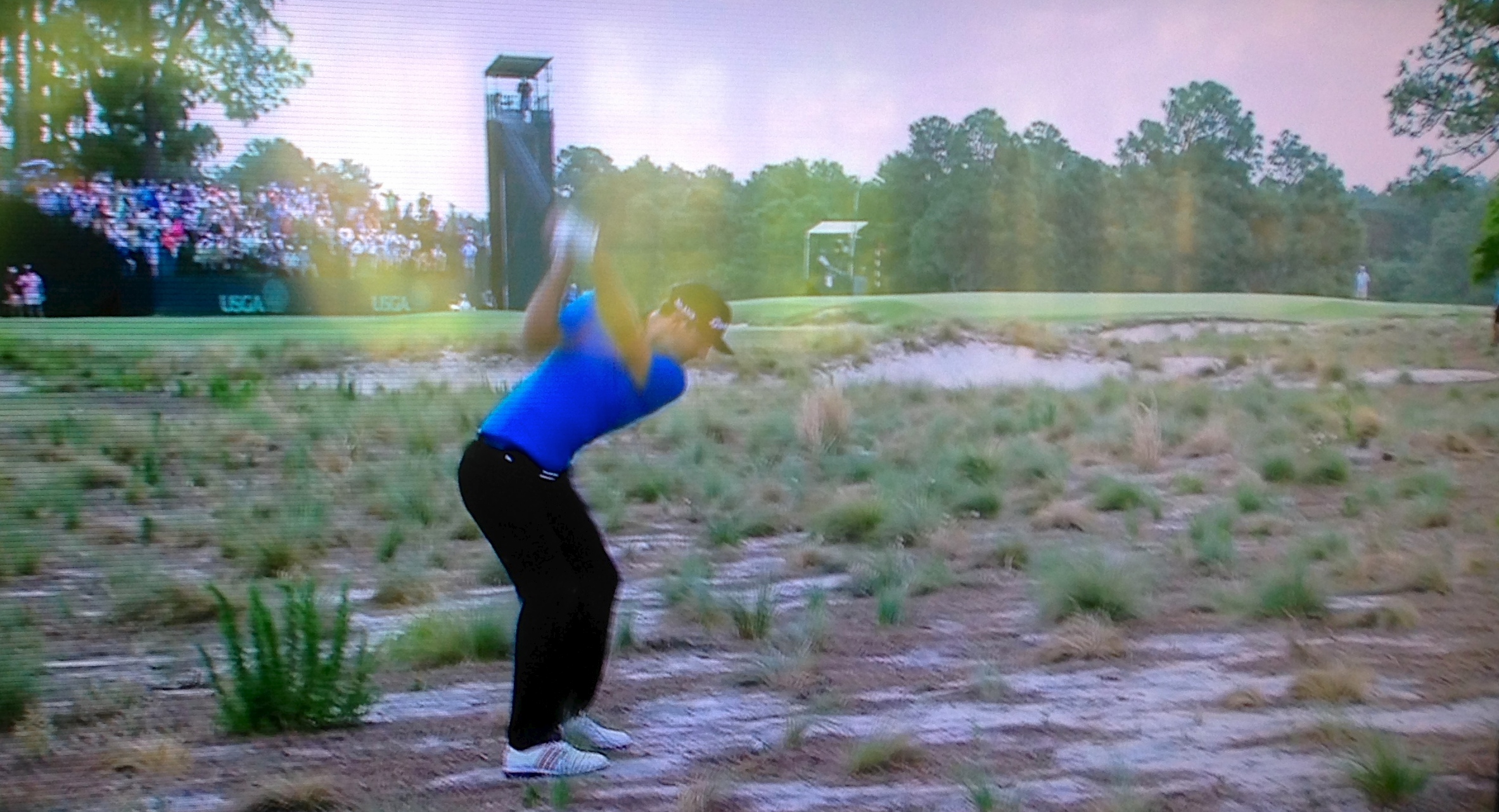
I've watched about 3 hours of the U.S. Open coverage so far this morning, and it has been great.  The ball is running, especially on the outsides of the fairway.  Sometimes this can be a distance benefit, as Phil Mickelson showed on his back nine, but often times flirting with danger leads to danger as balls run off into the "new" sandy native rough.  However, said danger is not the end all be all it used to be.  The natural mix of wire grass, pine needles, sand, wildflowers, and anything else can provide a stifling lie, but as we have seen so far today, many times it provides a chance for recovery and even a chance at going at the green.  This approach to areas off the fairway is a far cry from U.S. Opens past.  Speaking of those greens, the short grass is still present just as it was in the previous two U.S. Opens at Pinehurst.  This time around though the turf seems to be firmer and faster, encouraging even more play off the great and bold contours of these green surrounds.  Some greens like the 6th so far are showing that they are going to need either perfect shots to hold them or require a run in from off the green.  It hasn't happened too much yet because the greens received some water this morning, but the players will adapt as the surfaces firm up and they keep going long.  The firmer conditioning in the approaches will allow for this run in option, and it is going to be fun to watch as players now interact with the ground instead of firing darts.  

In 1999 and 2005, this was a hack out.  Now, Dustin Johnson and other players have a chance not only at advancing the ball, they can even sometimes fire at the green as he did here.

In 1999 and 2005, this was a hack out.  Now, Dustin Johnson and other players have a chance not only at advancing the ball, they can even sometimes fire at the green as he did here.

I am not going to call Pinehurst No. 2 a links, because it isn't (the closest categorization would be some sort of warm-season heathland).  I'm not going to call the U.S Open 'The Open' either.  However, both Pinehurst and the USGA are embracing the ideals of the game as it began and how it still is on many stretches of links land along the coasts of the British isles.  Firm turf, an attention to how it plays versus how it looks, a totally natural sandy appearance, less watering and maintenance with great environmental benefits, wider fairways with better angles and more options, and short grass around the greens are all ideals in line with the natural game.  And the great part about all of this is that the USGA is doing this without compromising what they like from their own end--defense to scoring.  Players are still struggling to get below par, but the great difference here is that it is no longer the slog and hack fest of years past.  There are chances for recovery, options for approaches into greens, and opportunities for creativity around the greens.  

It's still the same testing U.S. Open golf, but it is much more interesting and compelling U.S. Open golf.  

Bunkering in Brazil by Brett Hochstein

The first hole at Fazenda Boa Vista (Palmer) during grow in

The first hole at Fazenda Boa Vista (Palmer) during grow in

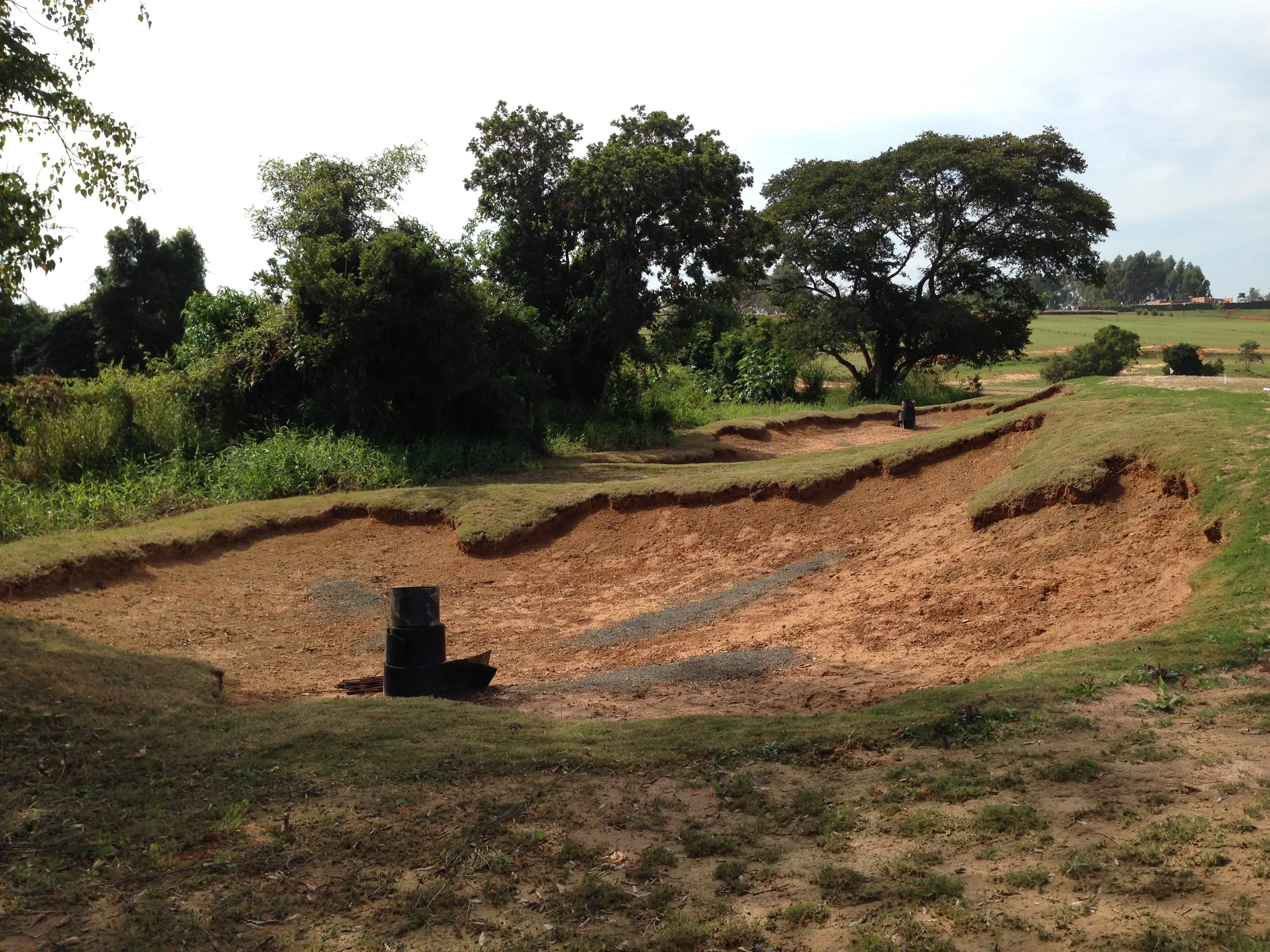
I had the fortunate opportunity to fill the month of May with some work for Arnold Palmer Design Company on their new course down in Porto Feliz, Brasil--about an hour and a half west of Sao Paulo--at Fazenda Boa Vista.  The main charge for the month was to go through all the bunkers, most of which at this point had already been established in grass.  There were still some bunkers in the dirt though awaiting to be grassed.  For these, it was decided that with a few simple moves and a couple of laborers, the work could be done by hand to avoid extra cleanup and also free up the excavator for other uses and keep the grassing program moving along, especially with the growing season for warm-season bermuda quickly coming to a close.  With my new hard-working amigos that spoke none of my language and me only a tiny bit of theirs, we set to chipping away at the hard soil and resetting the lines, mainly either simplifying them or extending them on the low corners.

Hole 15 fairway after edits.  The foreground bunker was extended left and made to look like it is sweeping more down the hillside.  The bunker in the far ground had the squiggly-ness of the low left side both toned down and outer points ad…

Hole 15 fairway after edits.  The foreground bunker was extended left and made to look like it is sweeping more down the hillside.  The bunker in the far ground had the squiggly-ness of the low left side both toned down and outer points adjusted to create a "connect the dots" curve.

It should be said that ProGolf Brasil, the contractor at Boa Vista, shaper Jeff Stein, and lead architect from APDC Thad Layton did a nice job of  building "good bones," or pretty nice starting shapes in the bunkers, and this made my job imminently easier.  

With the bunkers that had already been grassed, they were all mostly in good shape with really nice movement in the edge lines.  With some tamping with the back of a rake, some sharpening of corners with a flat shovel, and some textural "roughing up" of the edges with the same shovel, the bunkers began to take on a much more natural and aged look.  Nowhere was this more evident than on bunkers where the protective plastic liner had just been pulled.  

Hole 8 green side just after the plastic storm erosion liner had been pulled.

Hole 8 green side just after the plastic storm erosion liner had been pulled.

Hole 8 green side after finishing the edge.  A corner of the back bunker was also cut up higher to make it visible from the approach; before it was totally blind.

Hole 8 green side after finishing the edge.  A corner of the back bunker was also cut up higher to make it visible from the approach; before it was totally blind.

Hole 8 fairway bunker just after liner pulled and before any work done to it.

Hole 8 fairway bunker just after liner pulled and before any work done to it.

Hole 8 fairway bunker after edits.  Besides the textural improvements, a high point in the left center was detected and enhanced.  This move, along with heavily tamping down the right side, now gives a slight overall tilt to the bunker, wh…

Hole 8 fairway bunker after edits.  Besides the textural improvements, a high point in the left center was detected and enhanced.  This move, along with heavily tamping down the right side, now gives a slight overall tilt to the bunker, whereas before it had a bit of a flat line on top.  It now has a more pleasing look and fits in better with the rest of the bunkers on the course.

The protective lining of the bunker edges was something new to me that I had not seen before.  While cumbersome to move and adjust to the bunkers that were still in the dirt, there were some real benefits to them.  For one, they did seem to hold the edges fairly well.  They also provided some irregular movement to the lines as material outside would bow out the liner in between stakes toward the center.  Further yet, the lack of compaction from the sand cap at the edge left it soft and provided flexibility to tamp it and roll it down as much as desired.  All of these factors aided in being able to easily come up with the rugged texture and style seen above.  I would consider utilizing this method again in the future.

A good number of the other bunkers had had the liner removed for some time.  The program was still largely the same, though from growth and/or settling of the sand cap, the before and after comparisons are not as drastic.

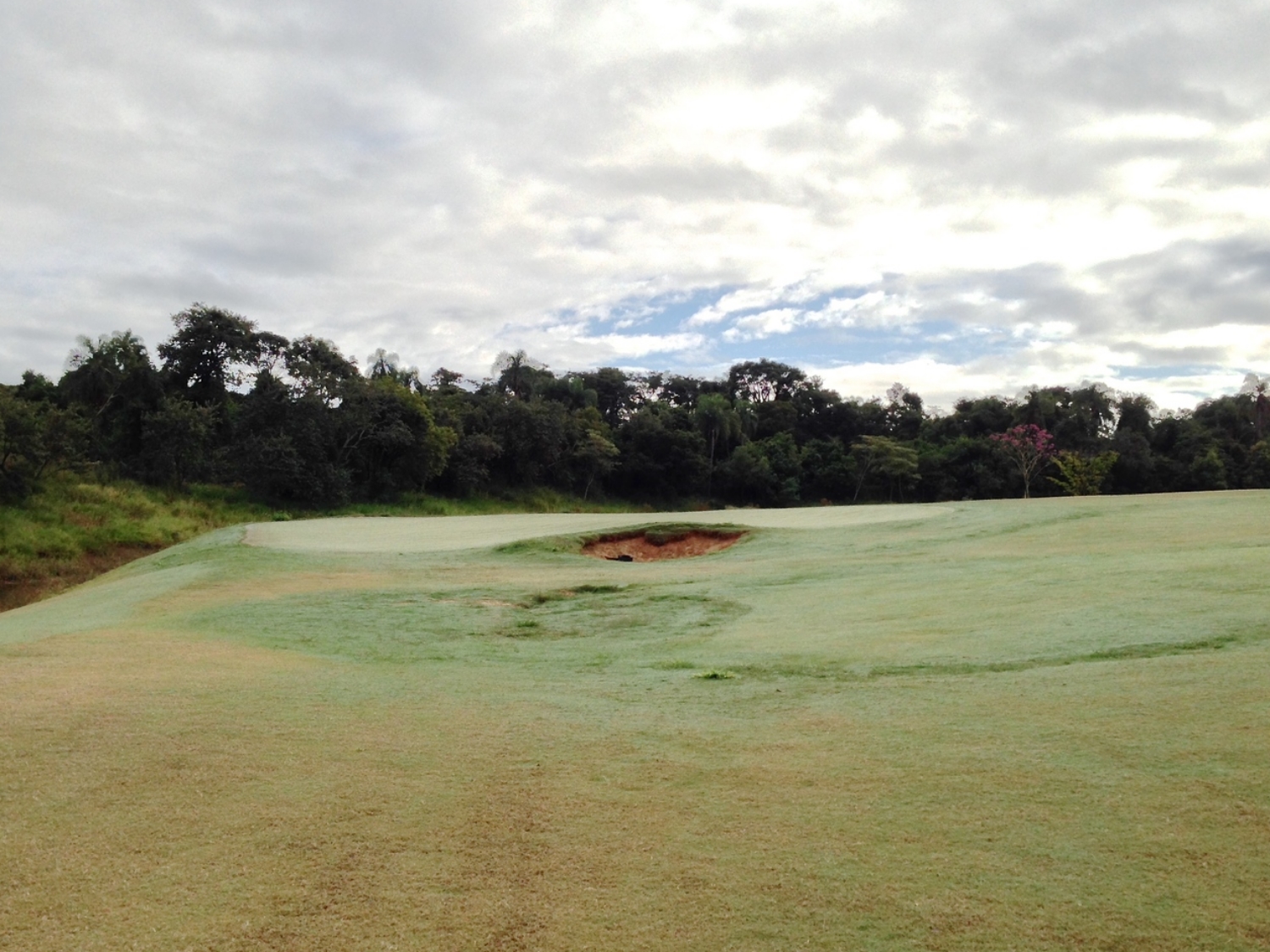
This nasty little green side bunker on 7 had a very symmetrical look from further back in the fairway.  The goal was to get away from that symmetry.

This nasty little green side bunker on 7 had a very symmetrical look from further back in the fairway.  The goal was to get away from that symmetry.

Making the nose stick out a little more and flaring up the right side helps alleviate some of the symmetry.

Making the nose stick out a little more and flaring up the right side helps alleviate some of the symmetry.

This bunker guarding the second shot on 5 might have been the most "municipal" of all bunkers in that it felt both really simple and not fitting with the land.

This bunker guarding the second shot on 5 might have been the most "municipal" of all bunkers in that it felt both really simple and not fitting with the land.

After image of the same bunker, now fitting in better with the style of the rest of the course.

After image of the same bunker, now fitting in better with the style of the rest of the course.

Hole 5 provided some of the biggest challenges, mainly with the front two bunkers, which were much more rounded and flat in the foreground.  They did not really fit in with the rest of the course or the hole itself.  After mental wrestling trying to come up with an easy solution, there was no other choice but to add some sod to the high sides and recontour some of the foreground.  

In addition to the roundness of the first two bunkers, the two bunkers from this back tee are much too similar in size.

In addition to the roundness of the first two bunkers, the two bunkers from this back tee are much too similar in size.

Corner flares, a sod tongue, and foreground contouring were all added to the two front bunkers in attempt to get them more in character with the rest of the course.  The front left fairway bunker was edged to better reveal the&nb…

Corner flares, a sod tongue, and foreground contouring were all added to the two front bunkers in attempt to get them more in character with the rest of the course.  The front left fairway bunker was edged to better reveal the flare up on the left and open up the front right; it now feels larger than the second bunker on the left.  Lastly, the first tongue on the left in the big bunker was cut back to differentiate it from the others.

I would not call it perfect now, but it is an improvement.  What you aren't going to improve much though is the strategic location and sizing of all the bunkers, which is really the most important thing anyway.  This hole, along with the other par fives at Boa Vista, features bunkers that both make you think and challenge you on all shots--a hard thing to pull off on a par 5.  Thad Layton and Arnold Palmer Design Company are doing great work and moving the company in the right direction.  It was really enjoyable for me to work with them and help contribute to what should be a very fun golf course.

I would like to thank ProGolf Brasil as well for being very easy to work with.  When I needed tools or labor, I got them.  Whenever I wanted to be left alone to think and work, they let me do my thing.  I think that not only helps things get done, it helps them get done well.  I'm a believer that a happy crew or individual leads to better and more creative work.  That is something that Tom Doak's Renaissance team really emphasizes, and it obviously shows in the results there.  ProGolf is just getting started on finishing the Olympic Golf Course in Rio de Janeiro, and look for them to only get better as they work along with Gil Hanse's talented crew.

The 4th at Boa Vista, with one bunker containing test sand.

The 4th at Boa Vista, with one bunker containing test sand.

Welcome to the new site! by Brett Hochstein

Welcome to hochsteindesign.com and my first blog post herein.  I anticipate using this page to present periodic news, reviews, and opinion as it comes to me.  Check back soon for a new post!

To all my friends and family back in the Midwest and Northeast, Spring is coming!  Yahnundasis CC, New Hartford, NY

To all my friends and family back in the Midwest and Northeast, Spring is coming!  Yahnundasis CC, New Hartford, NY